How to grant access to Business Manager
Facebook Business Manager is essential when you want to start running Facebook ads, and here we will show you how to set it up.
PPC advertising is an acronym for Pay-Per-Click, which means you pay only when someone clicks on your ad, rather than when it is simply displayed. This makes PPC an attractive option for small businesses with limited budgets or those just starting their online journey. Furthermore, PPC advertising can generate over 50% of your business revenue, so focusing on this area is a very safe bet. PPC also allows you to collect data faster and drive visitors to your e-shop or website who can then be categorized into segments in Google Analytics—giving you insights into their gender, interests, and location. You can use this data to make more informed, relevant business decisions in the future. It is not all sunshine and rainbows, though; there are downsides. In 2023, e-commerce saw a decline of around 25 billion, the first time in history. Until now, the graph had only been trending upward.
Systems that utilize PPC advertising include all social networks—Google Ads, YouTube, LinkedIn—as well as platforms like Heureka, Sklik, Biano, and Kaufland Marketplaces. I want to focus primarily on Google Ads because it is the largest; whenever a user wants to go somewhere, buy something, or find information, they go to Google and enter a search query. There are over 3.5 billion search queries on Google every day, and Google integrates eight other search platforms, such as YouTube, Maps, Gmail, and Android. Google holds a 92% market share in search engines, is the fourth most valuable company in the world, and 80% of its revenue comes from Google Ads. That is why I focus on Google Ads—it is simply the most advanced. At the same time, all the principles we will discuss in this and subsequent videos can be applied to other systems like Sklik, price comparison engines, or Facebook.
Google Ads is an advertising solution where we set up campaigns. We create strategies to cover the entire customer buying process and aim to feature as much of your product range or services as possible. Google Ads also involves campaign optimization, where we fine-tune the cost-per-click, click-through rates, and conversion rates. We monitor which products are selling well and which are not, and we exclude the underperformers. We will discuss this in more detail in the next video, which will be dedicated entirely to optimization. Naturally, Google Ads also allows for evaluation, so we can see what is working and what is not, and adjust our advertising and future campaigns accordingly.
There are several options, such as increasing traffic, boosting revenue, or generating leads. If you have an app, the goal might be app downloads. If you are a larger company, it could be about building brand awareness or consideration. Google Ads is built on three principles. The first is relevance, which means ensuring the search query matches the displayed ad and the landing page as closely as possible. The second is control , meaning we can turn campaigns off at any time, adjust budgets, or modify the cost-per-click for individual keywords or products. The third principle is results. Results are the reason I got into PPC; I love the measurability and the fact that we can tell a client whether our work makes sense, whether it is making them money, or if it would be better to focus on other advertising channels.
PPC advertising works on an auction basis, but it is not simply a case of the highest bidder winning the top spot; it depends on several factors. These factors include cost per click, but there are other factors such as ad quality at the time of the auction. This consists of the expected click-through rate, relevance, and the landing page experience. Google evaluates your page—the one you direct people to. It checks if everything is well-written, if anything is missing, if the layout is clean, and if it contains all the necessary information. Google crawls this in advance and uses it as one of the parameters for ad ranking. The third element is search context. Google considers your location, the device you are using, the time of day, and various other signals. As I mentioned earlier, Google Search integrates with other platforms like YouTube, Gmail, and Android, and Google incorporates these signals into search to personalize content for you.
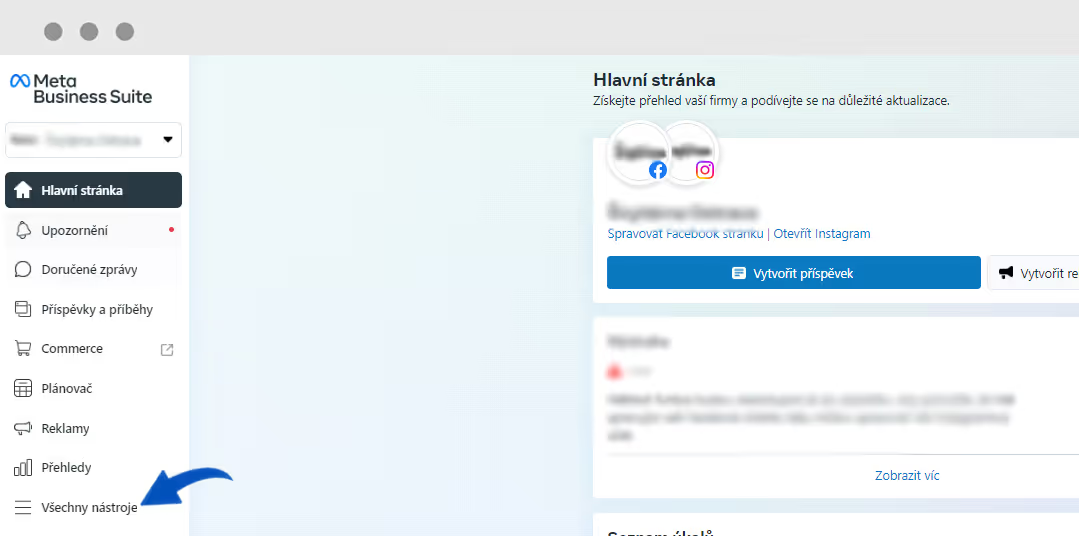
Facebook Business Manager is essential when you want to start running Facebook ads, and here we will show you how to set it up.

An interview about performance advertising and current trends.

3 days of the most interesting PPC know-how. That was the 14th PPC Camp, where we enjoyed 20 presentations from industry leaders that were definitely worth listening to.
Don't miss any important events or news from our world