How to grant access to Business Manager
Facebook Business Manager is essential when you want to start running Facebook ads, and here we will show you how to set it up.
We’ve spent over 200 million CZK for our clients and generated over 1 billion CZK in revenue for them. I’ve processed over 5,000 emails, completed more than 3,500 tasks, and participated in hundreds of client meetings and calls. I only had a free weekend once every three weeks. This eventually led to health issues. But I’m getting ahead of myself—let’s take it from the beginning.
Before founding Adsvantage, I worked as a freelance PPC specialist, but freelancing is difficult to scale. You mostly work alone, which really bothered me. At the same time, I wanted to build something bigger, and I knew that wouldn't be possible without talented people. However, I was a hardcore specialist focused solely on marketing and advertising systems. I didn’t know how to manage a team, handle finances, or design services. I do have a bachelor’s degree in economics with a focus on marketing—that’s where I started building my know-how. Even so, it wasn’t enough, and a long road of learning lay ahead.
I am a systematic person, so I created a lot of notes from the information I gathered. To keep from getting lost in them, I use an information flow (inspired by Petr Mára and his lecture from iCON 2014). Nowadays, we are bombarded with so much information that it’s impossible to absorb it all. When a heavy workload or pressure from clients hits, the brain also comes under pressure and is more prone to making mistakes. Information flow consists of two interconnected mind maps: one describes how you receive information, and the other where you store it.
Business is all about creating processes, so it’s great to be able to return to your information flow at any time. Because once you invest in becoming an entrepreneur, you want it to be for life.
I’ve read thousands of articles, listened to hundreds of hours of podcasts, and spent hundreds of thousands on conferences, consultations, and training. Yet, I was still missing a comprehensive source of information. Strategist Michal Krutiš helped me with that through his Agency Orchestration. I turned it into the largest mind map I’ve ever seen. I was even more influenced by Jan Mühlfeit and his idea: "Do all your activities based on your strengths."
On Gallup StrengthsFinder, you can answer 177 questions for 450 CZK. The test then evaluates your top 5 strengths. And how do you work with them? When you perform activities through your strengths, it’s easier to get into a flow state, and you’ll enjoy your work more.
One of my strengths is "Maximizer." I remember walking into the office one day and drawing on our whiteboard how we would reach 25 million in two years. My colleagues stared at me as if I’d fallen from Mars. I sobered up after a few months because if I did everything through my Maximizer strength, I’d only have plans, visions, and hype, but no actual work would get done. Knowing my strengths, however, helped me understand which colleagues I needed to hire to complement me.
Every one of my colleagues has taken this test, and we delegate work based on the results. Some things can be delegated immediately, while others you must learn yourself so you can ensure the quality of the work delivered.
I’ve talked about soft skills so far; now I’ll show you the topics I deal with in the company:
You’ve surely heard that people are the most important part of a company. For a long time, I felt I could handle everything myself, but now I have to confirm that people really are the most important asset you have. For me, working with a team is about finding the balance between ensuring colleagues enjoy their work and the company delivering the results we’ve promised. I shortened working hours from 160 to 140 (meaning colleagues only have to work 7 hours a day). Previously, we had it set up so everyone worked six hours a day and had one hour for study—articles, podcasts, videos. The problem that arose, however, was that everyone was consuming and reading the same information. Now they work seven hours, and team leader Martin Kisza is responsible for reading those sources himself and then sharing them with us at regular meetings.
I support bonuses for client expansion, portfolio growth, and writing articles. Our company culture is built on a clear vision and values focused on developing our clients' businesses, staying up to date with news and best practices, and celebrating client success. Company operations are primarily about work efficiency and tracking KPIs. I monitor efficiency based on time spent on clients, which helps us plan what to focus on more and what to focus on less.
Automating repetitive tasks is a must. Reports, invoices, scripts. The KPIs we track are cash flow, revenue, profit, and revenue per employee.
Marketing should always be based on a strategy. I’m not saying it has to be the very first thing—after all, you don’t have everything figured out the moment you start a company. I would recommend starting with a Lean Canvas business plan on a single page. If you're just starting out, you just need to know where you'll get your customers. Only once you have stable cash flow would I dive into creating a full strategy.
A visual identity is a document that defines your graphic elements, logos, and colors to help you stand out from the competition. Are you building a website or creating social media posts? The simplest step toward generating leads is getting listed in directories. But you can't stop there.
Content creation is essential. Based on media plans, we create case studies and social media posts, and offline events are also extremely important. Attend conferences and networking events in your industry.
Without promotion, things will move much slower. My philosophy is that if I’ve already spent 20 hours creating a case study, I have no problem putting a few thousand into advertising so that as many people as possible see it.
You need social proof. I focused on becoming a Google Certified Trainer, a Gold Shoptet Partner, a Gold Mergado Partner, and a Heureka Partner. I’ve been a guest on the PPC Podcast CZ and also moderated the largest Czech e-commerce event, Czech On-line Expo.
Service quality directly impacts your pricing power. You have several options to choose from—you can price based on projects, fixed hourly rates, a percentage of costs, or performance-based components.
Implementation methodology is about defining who does what, which is why it’s essential to have checklists prepared in advance and simply duplicate them for every new contract. I have templates for proposals, intake questionnaires, onboarding, pre-client setup, optimization, and development—for every service we offer.
Service delivery involves, for example, reviewing our outputs with clients to ensure we don't release anything the client doesn't want. But the most important question is: does our work provide more value than it costs?
Our client communication is built on transparency, proactivity, and empathy. Client relationships are about the onboarding process and matching the right client with the right specialist. I make these assignments based on experience, interests, and budget. The goal is to have the right people on the right projects.
I try to simplify the actual client collaboration process as much as possible. We use a CRM, Gmail, Google, chat, and the phone. Internal meetings are focused on optimization, operations, and finance, while external ones are for client communication. From a financial perspective, I primarily monitor cash flow—our CRM is linked to our bank, so I know exactly where we stand in real-time.
Revenue is either one-off or recurring. We strive to secure recurring contracts, which is why it is crucial to understand the client's business right from the start and deliver added value as quickly as possible.
The costs a company generates include employee expenses (such as laptops, mice, monitors, standing desks, or even coffee), as well as production costs (software expenses—we use Supermetrics, Google, or website hosting). We spend about 30,000 a month on Google and Facebook advertising. Education and attending conferences are definitely part of our costs, too—you can't just work and spend hours on clients; sometimes you spend the whole day visiting events like PPC Restart, Mergado Fest, Czech On-line Expo, and other Czech training events. And then, of course, there are taxes.
Profit and its forecasting are vital for planning the company's future growth. Revenue diversification is a major topic for me—we would rather have more mid-sized clients than just a few huge ones, where losing even one would be a problem for us.
Then comes the hard work. I used to have a free weekend once every three weeks, but I did set certain limits, such as not working more than 10 hours a day or more than 5 hours on the weekend. My work is very mentally demanding, and if I sat at the computer for 15 hours a day, I would be completely drained and unpleasant to my colleagues the next day.
I have conducted over 300 audits and have managed, optimized, and communicated on hundreds of client accounts. On top of that, Meta, Google, and the entire e-commerce sector are evolving at a rocket-like pace, and keeping up with everything is truly extreme. It was a demanding period—I was a salesperson, specialist, strategist, and project manager all at once. One day, my body said enough. When I was going to a conference with Martin, he told me I had a bald spot on the back of my head. I thought I had annoyed my barber, but then I realized my hair had fallen out from overwork and stress. At that stage, I couldn't slow down because we had so many projects underway, but it helped me change how I look at collaborations and stop stressing unnecessarily.
Today, my workload isn't as fragmented; I have fewer roles, which allows me to focus on them more deeply. Something I attribute great weight to regarding my business growth is that my brother and I have been subscribing to Forbes magazine for 10 years. We talk about the interesting articles and stories in it.
When I reached nearly 8 million, I could have bought a new car, but I prefer to keep driving my Fabia and save capital for future projects. Money is nice and gives you great opportunities, but I get more joy from the people I have around me, and I know that together we can launch any project (and we already have a few ready in the drawer).
When I started thinking about entrepreneurship, it bothered me that I didn't know anyone who spoke openly about their business. Now, I’m offering that to you. Everything will revolve around business, inspiration, education, entertainment, and how I, as a CEO, lead my company. Preparing the video you see above took me over 50 hours. That’s why I invite you to check out more of our content. Follow us on social media, and see you next time!
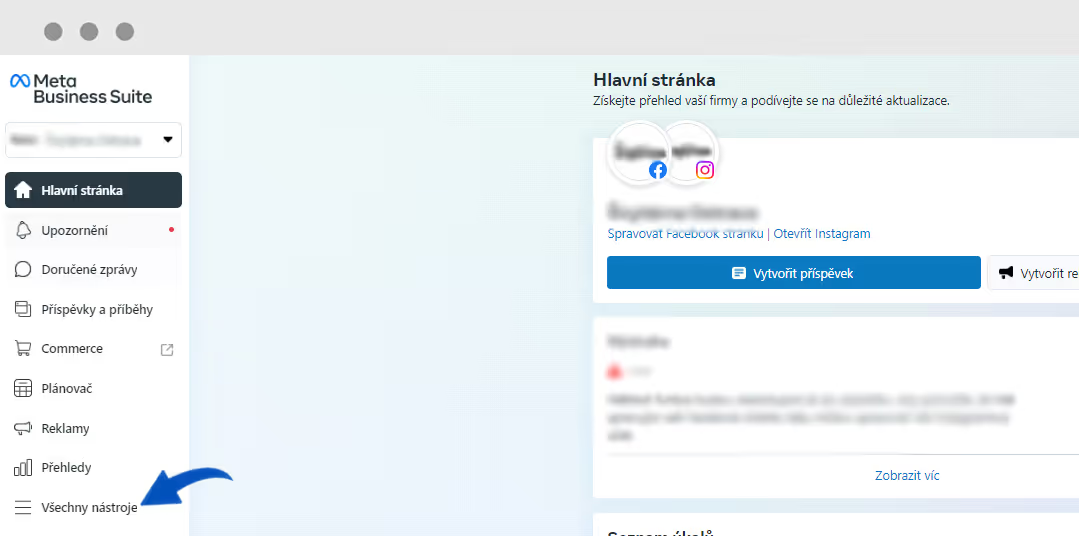
Facebook Business Manager is essential when you want to start running Facebook ads, and here we will show you how to set it up.
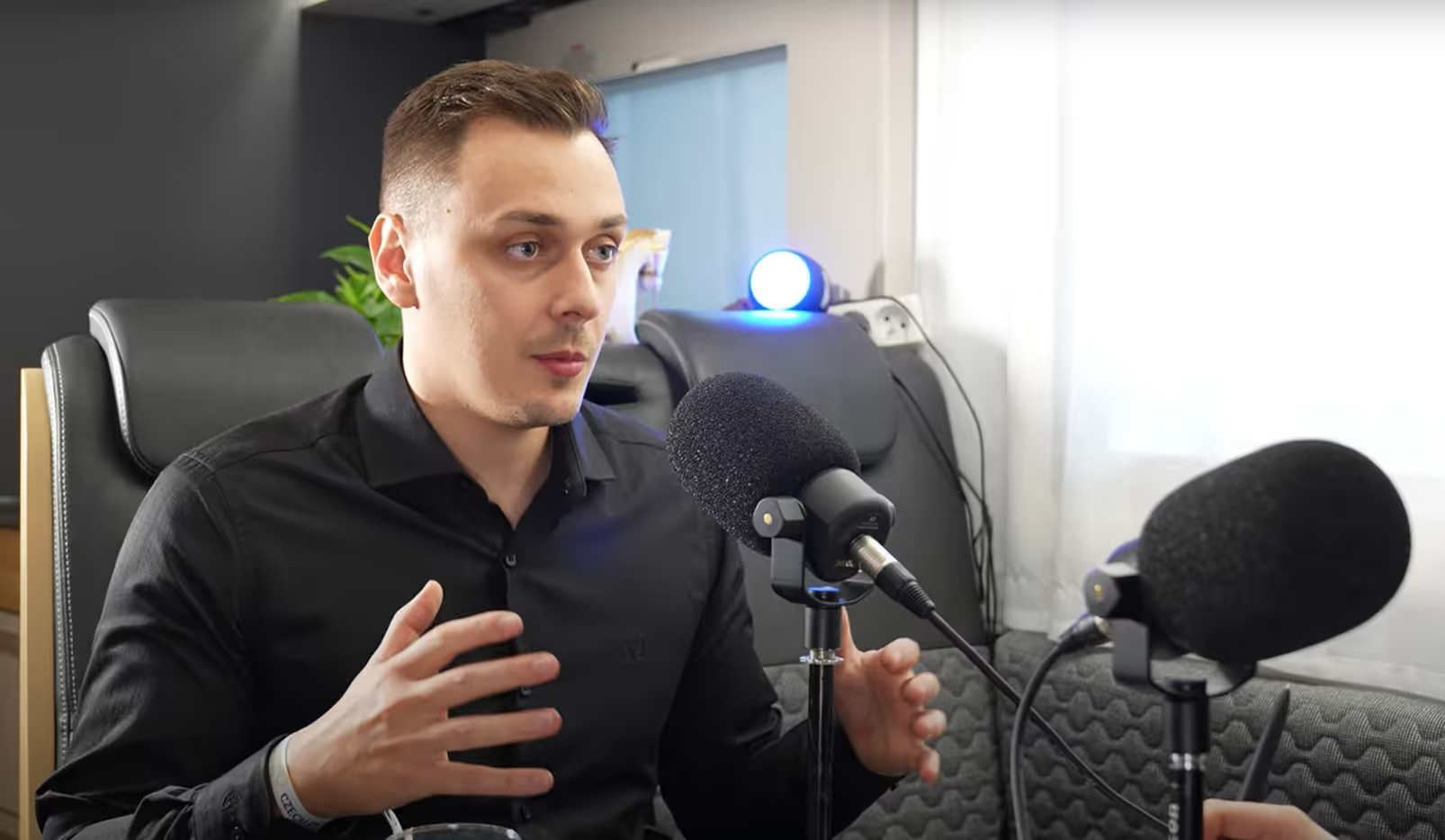
An interview about performance advertising and current trends.
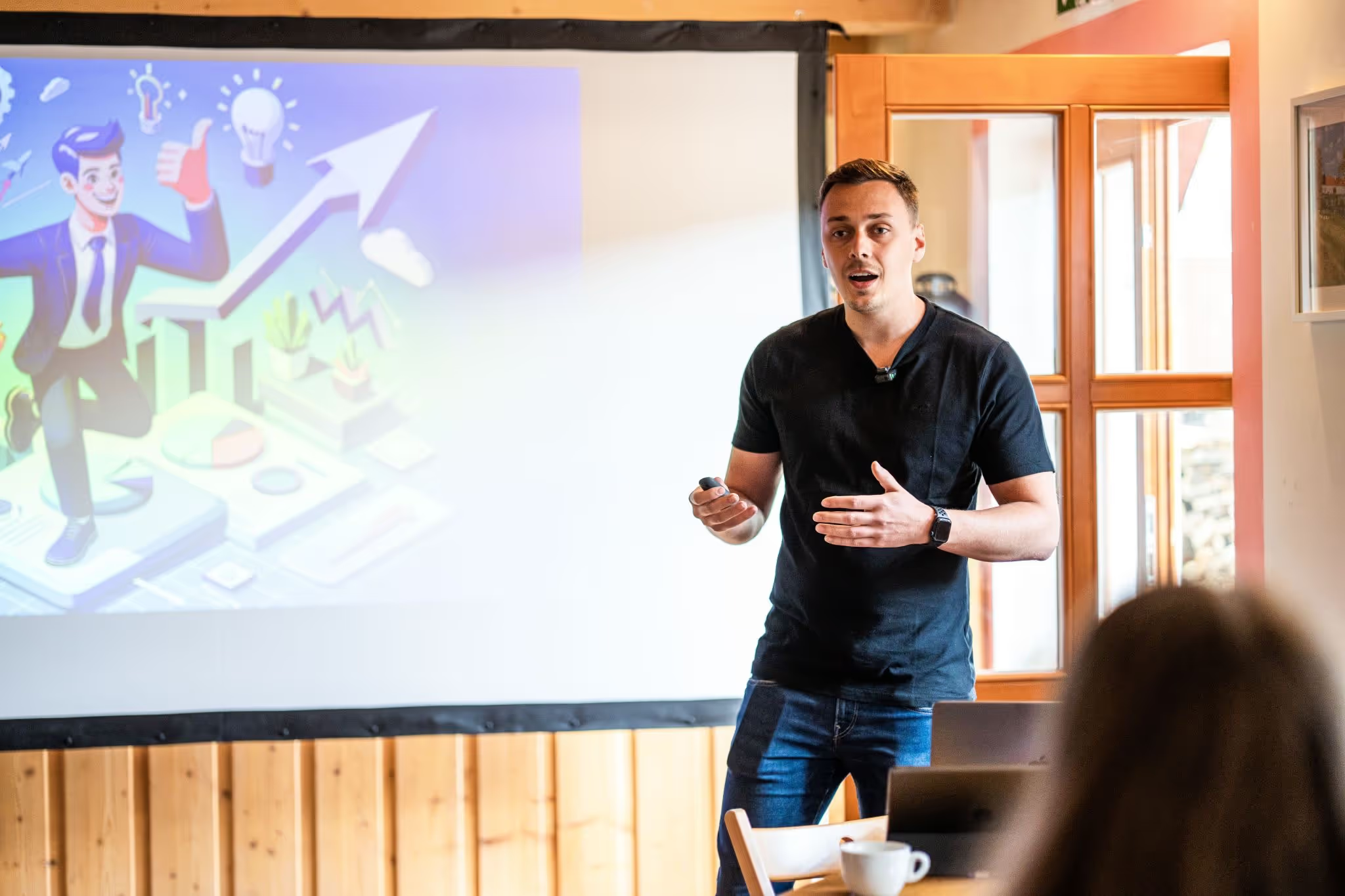
3 days of the most interesting PPC know-how. That was the 14th PPC Camp, where we enjoyed 20 presentations from industry leaders that were definitely worth listening to.
Don't miss any important events or news from our world