How to grant access to Business Manager
Facebook Business Manager is essential when you want to start running Facebook ads, and here we will show you how to set it up.
Looking for a simple and effective tool to ensure you never forget anything when preparing PPC campaigns? Here it is! Let’s take a look at our practical PPC checklist, designed to help you plan, launch, and manage your advertising campaigns.
With this checklist, you won't miss a thing. From selecting the right keywords and defining your target audience to setting your budget—every step matters. In the following lines, we’ll look at how to combine these elements effectively and where to begin.
To create a successful PPC campaign, don't forget a thorough keyword research. Tools such as Google Ads Keyword Planner, the Czech Collabim, Seznam Keyword Suggestion, Marketing Miner, kwfinder.com or keywordtool.iocan help you identify the most relevant keywords to focus on. Try to find keywords that are not only relevant but also long-tail to avoid high competition and high cost-per-click.
Once you have found the right keywords, do not group them all together. Instead, divide them into smaller ad groups containing a maximum of 15–20 keywords from a specific category (ideally, they should reflect the products on the landing page you are targeting). This ensures your ads are more relevant to specific searches.
The rule is that every adgroup should focus on a specific aspect of your product or service. This means each ad will target potential customers more precisely, which will increase the effectiveness of your PPC campaign.
The landing pagethat your customers click through to from your ad is one of the key elements of your PPC campaign. It is your chance to make a great first impression, which will be the difference between whether people stay and buy, or leave and never return.
The most common mistake is that visitors didn't find what the ad promised. Keep in mind that losing a visitor due to confusion on the page = losing a potential customer. For example, if you offer a discount on a specific product in your ad, the customer should find that information on your website right away.
Also pay attention to the design and clarity of the page. Nobody likes clutter. Look at your landing page through the eyes of your buyers and check if it's easy to navigate and everything works as it should.
Don't forget about page loading speed, because slow loading times can drive users away. And of course, test different versions and track the results so you can optimize your conversion rate.
At the same time, keep in mind that the page should evoke an emotion and solve the buyer's problem/need.
The success of your PPC campaign lies in precise targeting. In Google Ads, you can easily choose who sees your ad and play with parameters such as location, age, or even the device on which the ad is displayed.
Imagine you have a product that is ideal for seniors. Why would you pay for millennials to see your ad? Or, if your business operates in a specific region, set your ads so that only locals see them. This way, you not only save money on advertising, but more importantly, you get it directly to those who will appreciate it the most.
The best way to measure the success of a PPC ad is to track how many conversions it generates. This is a truly critical point for Google campaigns – after all, you really cannot do marketing these days without proper measurement. Therefore, make sure you have conversion tracking set upcorrectly. Simply place the tracking code on the page your customers reach after a successful purchase. With this code, you will have an accurate overview of your ad performance and a great springboard for future optimization.
You can access the code by creating an Analytics account and going to Admin > Tracking Info > Tracking Code.
Work with negative keywords as well. These are words or phrases for which you do not want your ads to appear. Why? Because sometimes your ad might appear in search results that are completely unrelated to what you offer, and you would still pay for the click. Yet, this is easily avoidable.
Compile a list of words that are irrelevant to your business. For example, if you sell antiques but not furniture, you can add "antique furniture" as a negative keyword. This prevents your ads from showing to people looking for something else and avoids wasting your budget.
You’ve checked and configured the previous steps, and now you can just sit back, put your feet up, and enjoy the new orders. Unfortunately, that’s not how it actually works. An effective PPC campaign requires daily attention. Remember that without regular care and adjustments, you can waste not only time but also money.
Here are a few key things you should do in your daily PPC routine:
Every day, you should check your two main key performance indicators (KPIs) – specifically ad spend and profit.
These numbers give you an idea of how well your advertising investments are performing. Determine the return you are getting on every dollar you put into advertising and identify which ads are the most profitable for you.
But don't forget about other KPIs, such as click-through rate (CTR) and quality score. These will provide deeper insight into how your ads are performing. If you come across an ad with a low CTR, it means that few people are clicking on it. In that case, consider changing the ad copy or the keyword.
It may happen that some keywords simply don't perform as well as you'd like. You can easily identify this in GA4 using the Explorations feature to create your own report, or in Google Ads using the data you started collecting via the tracking codes from the previous step.
If you notice that a keyword isn't delivering the expected conversions, it's time to pause it. There is nothing to be afraid of. In fact, it's a smart move that helps you make the most of your budget. Don't waste money on keywords your customers aren't searching for; instead, give priority to those that bring you results.
You've already mastered your daily PPC routine. Now, let's look at the steps that are worth taking at least once a week:
PPC campaigns aren't just about tracking ad performance. Managing your budget carefully is just as important. Check how much you are spending on individual ads. Sometimes, an ad might get a lot of clicks, but those users don't end up making a purchase.
When you come across such an ad, it's time to adjust your bids or even reallocate part of the budget to more effective ads. Manage your budget wisely.
At the same time, you need to monitor the smart bidding strategies in your individual campaigns and their overall efficiency. Determine whether you are utilizing the full potential of your campaign given your current strategy. Evaluate whether the chosen strategy is optimal for your performance. Check if the set value is undervaluing a campaign that has no chance of entering individual auctions, or conversely, if your campaign is entering irrelevant auctions due to an incorrectly set goal.
We are reaching the finish line with a list of activities you should perform at least once a month:
How else can you improve your PPC campaigns? One great way is to look at data about your website visitors. Metrics like time spent on site and bounce rate will provide you with valuable insights into what is working and what needs a closer look. You can find this data in Google Analytics.
If you find that one of your landing pages has a high bounce rate, it may signal that people are not finding what the ad promisedView the page through the eyes of a customer, and feel free to edit or rewrite the text to make it clearer.
Your success is always influenced to a large extent by your competition. That is why you should take a moment every now and then to look through their ads. If you see that competitor ads are performing better than yours, take a look at what they are doing differently in their marketing. Perhaps they are using a clever feature or strategy that you haven't tried yet. Try to draw inspiration from them, and you might find that the same tactic works for you too.
In the digital world, things change quickly, and that also applies to how people search for information online. For your PPC campaign to be successful, it is important to stay alert and monitor how keyword trends are shifting. If people stop searching for certain keywords that you previously used in your ads, it is time for a change.
Don't forget about emerging keywordsthat may appear. Catching a new trend can significantly improve your campaign results. But how do you know what is currently in? A great tool for tracking these trends is Google Trends. Here you can see which keywords are popular right now and how interest in them changes over time.
Now you know how to keep your PPC campaign in top shape—by monitoring performance, making regular adjustments, and adapting to ever-changing trends. However, if you aren't sure if everything is working as it should, or if you feel like things could be even better, we have one final tip for you.
PPC audit from our experienced CEO, Michal Lysek, who will give your campaign a thorough check from A to Z. He will look at everything that matters—from your Google Ads account settings to how your conversion codes are configured.
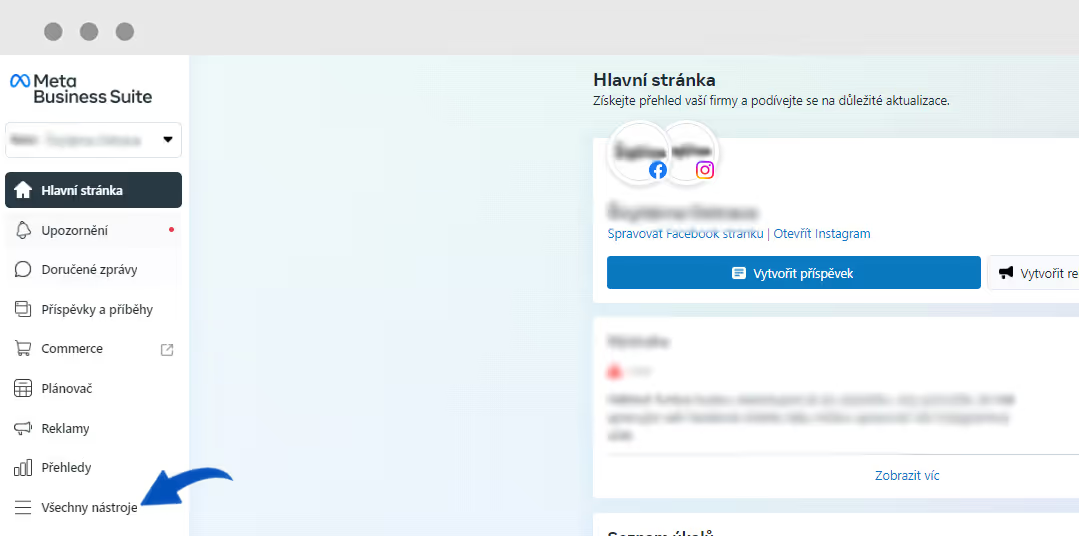
Facebook Business Manager is essential when you want to start running Facebook ads, and here we will show you how to set it up.

An interview about performance advertising and current trends.

3 days of the most interesting PPC know-how. That was the 14th PPC Camp, where we enjoyed 20 presentations from industry leaders that were definitely worth listening to.
Don't miss any important events or news from our world