How to grant access to Business Manager
Facebook Business Manager is essential when you want to start running Facebook ads, and here we will show you how to set it up.
Do you ever feel like you aren't maximizing your business's potential? That your decisions are just reactions to your competitors' moves rather than your own deliberate actions? If so, you aren't alone. Most companies "do business just to do business," but they lack the most important thing – a plan to build a long-term competitive advantage.
At Adsvantage, we have helped clients (such as Motozem or Pet Center) generate over 2.6 billion CZK in revenue. Along the way, we discovered that success isn't about luck. It's about strategy.
In the first part of our strategy series, we look at what strategy actually is, why the numbers clearly favor it, and how to learn from masters of asymmetry like Hannibal or Cold War strategists.
👇 Watch part 1 of the video course:
Many entrepreneurs think strategy is just a thick document sitting in a drawer. They are wrong.
Strategy is the connection between activities you have full control over and those you cannot influence, designed to create a long-term competitive advantage.
A real-world example:
Strategy isn't about one isolated activity. It's about a thoughtful combination of all key steps.
You might be telling yourself there’s no time for planning. But the data shows otherwise:
The core of strategy is decision-making. Michael Porter, the father of modern strategy, put it clearly: "A company cannot be everything to everyone. It must choose. It must decide which things it will do, and which things it will NOT do."
It might sound scary. Turning down an opportunity? Narrowing your target audience? Yes. Because when you see an e-shop selling luxury cosmetics right next to garden equipment, your trust in their expertise plummets. Specialization builds trust.
How do you gain a competitive advantage when your rival (the competition) has the same resources as you? Imagine two MMA fighters. Same weight, same height, same strength. Who wins? No one. Because an advantage never comes from where we are the same. It comes from differences. From so-called asymmetry .
The winner is the one who forces their game onto the opponent.
Strategy does not guarantee 100% success. In business (just like in poker), nothing is certain. But a good strategy dramatically increases your chances of winning.
Stop putting out fires and start building a solid foundation. In the next article and video, we will look at how to set goals that will actually move your company forward – and why the ones you have now are likely not enough.
👉 Download the worksheet for the video and start creating your strategy today: https://www.adsvantage.cz/blog/dlouhodoba-konkurencni-vyhoda
Most companies have a vision. Most companies have a mission. And unfortunately, most of them are just abstract wishes with no real impact on the business. Yet the data is clear: 90% of owners with clear goals consider themselves successful, compared to 71% of those without them.
In the second part of our strategy course, we will look at why your goal of "we want to grow by 10% year-on-year" is likely not enough for you to dominate the market.
In 2006, General Motors invested 40 billion CZK into the new Chevrolet Malibu model. The goal? To double sales to 120,000 units. Sounds ambitious? .
It was a disaster. At that time, the competing Toyota was selling 560,000 Camry units per year. The GM goal was essentially a plan for how to remain an insignificant player. The change only came when they set a winning aspiration: "We will build a car that is rated better than the Toyota Camry."
Only this goal, defined in relation to the competition, changed the engineers' mindset and led to success.
A strategic goal doesn't start in an Excel spreadsheet, but with the customer. If you understand their true needs better than anyone else, the numbers will follow.
A prime example is our client, the brand Holky z trhu. While the competition focused on perfection and neon colors, our data showed that their customers (women 45+) wanted the exact opposite – comfort and normalcy.
Your goal must be concrete and ambitious. It’s not enough to just want to "do business." You have to want to win. Winning in business doesn't mean others have to go bankrupt. It means your competitors would rather choose a different segment because they know you rule yours.
In the new video, we will show you:
👉 Watch part 2 of the strategy course right now.
In the last episode, we defined our Winning Aspiration. We know what winning looks like for us. But now comes the hardest part: Where will we fight this battle? Many companies make a fatal mistake—they try to be everything to everyone. The result? They end up being mediocre for everyone.
Imagine a general who sends their army "everywhere." What happens? They lose. Their forces become diluted. It’s the same in business. If your target customer is "anyone with a wallet," you don't have a strategy. You just have wishful thinking.
In the third part of our course, we’ll look at the strategic framework used by the world's best marketers. We call it Divide and Conquer (in industry jargon, STP – Segmentation, Targeting, Positioning).
👇 Watch episode 3 of the video course:
The market is like a huge, confusing map. The first step to dominating the market is to cut this map into smaller, logical pieces. Why?
But you don't have to divide the market just by where people live (geography) or how old they are (demographics). The smartest players divide the market by behavior (behavioral segmentation) and values (psychographic segmentation).We are interested in why they buy, what troubles them, and what problems they are solving.
You have the map divided into pieces. Now comes the critical question: Which piece will you choose?You cannot attack all segments at once (unless you are Amazon, and even they started with just books). You must choose the segment that is most profitablefor you.
How do you identify the right one? Look for the intersection of three factors:
Remember: The goal is not to choose the largest segment. The goal is to choose the segment where you have the best chance of becoming number one. It is better to be a big fish in a small pond than a minnow in the ocean.
You have your segment. You know who you are targeting. Now you must explain to these people why they should choose you. That is PositioningPositioning isn't what you do to a product. It's what you do to the customer's mind. What "box" will you occupy in their head?
Let's look at the masters of positioning:
If you want to dominate your market, you must clearly answer three questions:
The "Divide and Conquer" strategy requires courage. The courage to say: "We won't do this. We don't want to sell to these customers."But it is precisely this courage that frees your hands to become the absolute best choice in the world for your chosen group.
You have selected your playing field (Targeting) and you know which flag you want to plant there (Positioning). In the next episode, we will look at how to ensure that no one tears that flag down. We will talk about building a long-term competitive advantage.
In previous episodes, we defined our Winning Aspiration and chose our battlefield (segment). Today, we dive into the very heart of strategy – the question of HOW we will win. Most companies try to be a little cheaper and a little better than the competition. The result? They are mediocre. We will show you why you must choose only one path and how to dig a "moat" around your company that the competition cannot cross.
Imagine two fighters in a cage. They have the same weight, height, and strength. Who wins? No one. Advantage does not arise from what we have in common. It arises from differences. From so-called asymmetry.Your task as a strategist is to find or create an asymmetry that you force upon your opponent.
👇 Watch episode 4 of the video course:
Michael Porter, a legend of strategy, put it clearly: You cannot be everything. In business, there are only two fundamental paths to victory. You must choose.
It’s not just about being "cheap." It’s about having systemically lower costs than anyone else.
The goal is to offer something so unique that customers stop caring about the price.
The mediocrity trap: Many e-commerce owners (let's call our model example Erik) try to do both. They want a premium product at the lowest price. That doesn't work economically. Erik has to decide: either he optimizes processes to the bone (costs) or he builds a lovebrand (differentiation).
You've chosen your path. But what if your competition copies you in six months? Warren Buffett only invests in companies that have a so-called economic moat. That is your long-term advantage.
Here are 5 types of moats you can build (with examples from the Czech market):
Lock the customer into a system of services that work perfectly together.
Innovate so fast that your competition can't even keep up, let alone copy you.
It’s not just about how a product looks, but how the entire company "feels" to the customer.
Look at an old problem through entirely new eyes.
The one thing your competition truly cannot steal is your company culture.
A strategy without a long-term advantage is just a temporary tactic. Your task now is to consider: Which of these 5 pillars is the right one for you? Will you build an ecosystem like Alza, or will you bet on design like Footshop?
In the next episode, we will look at what specific skills you need to have in your company to be able to build this fortification. And I will reveal the secret of why the best companies often donot do everything themselves.
👉 Download the worksheet and define your competitive advantage. https://www.adsvantage.cz/blog/dlouhodoba-konkurencni-vyhoda
In the last episode, we drew a "moat" around your business – your competitive advantage. Now comes the hard reality: Who is going to dig that moat? And who will defend it? Many companies have a great strategy on paper, but they lack the "muscle" to execute it. In this episode, we will look at which skills you need to have in-house and which ones you must ruthlessly delegate.
Imagine your strategy is to win the Tour de France. You can have the best bike (product) and the perfect route map (market). But if you don't have the stamina and strong legs (skills), you won't reach the finish line.
In the fifth part of our course, you will learn how to identify the 3–5 key activities that determine your success, and why trying to "do everything in-house" is often a path to ruin.
👇 Watch episode 5 of the video course:
The first myth we need to debunk: Skills are not everything your company does.Don't confuse strategic skills with routine operations. Accounting, IT support, or office cleaning are necessary activities ("hygiene"), but they probably won't win you the market.
Strategic capabilities are the specific activities that directly build and strengthen your competitive advantage.
This is the hardest lesson for many Czech entrepreneurs. We have this feeling that "if you don't do it yourself, it won't get done right." But strategy says the opposite: To excel at what matters, you must be average at (or not do at all) what doesn't.
Let's look at the giant Procter & Gamble (Pampers, Ariel, Gillette). They realized that their winning weapon isn't manufacturing plastic packaging, but brand building and innovationWhat did they do? They decided that manufacturing or managing IT systems was not strategic for them. They outsourced these activities to partners who could do them better and more cheaply. As a result, P&G was able to focus 100% on marketing and development – the things that actually make them money.
Sit down with your team and be brutally honest with each other. Ask yourselves this question:
"Which 3 to 5 activities must we perform at a world-class level to deliver our promised value to the customer?"
We aren't interested in what you enjoy doing. We are interested in what your strategy requires. If you are aiming for speed (e.g., Alza), your core competency must be logistics and warehouse automation. If you are only "average" at this, your strategy will collapse, no matter how good your marketing is.
Competitors can copy one of your skills. They can buy the same software or outbid you for your specialist. But what can they not copy? How your skills fit together.
Michael Porter calls this "Fit". Your activities must reinforce each other like interlocking gears.
This airline wanted to be the cheapest in the US. What skills and activities did they choose to achieve that?
These things might not look connected at first glance, but the opposite is true:
If a competitor were to copy just the "no food" policy but lacked the fast turnarounds, they would only annoy passengers without saving a dime. The power lies in the system.
Look at your company. Do you have 3–5 core competencies that reinforce each other? Or do you have a pile of random activities that have nothing to do with one another?
Your task for this week is:
You have a goal, you have a playing field, you have an advantage, and now you know what muscles you need for it. In the final episode, we will look at what holds the whole company together so it doesn't fall apart in your hands. We will talk about management systems.
Welcome to the home stretch. We have gone through setting a winning aspiration, choosing a playing field, digging a moat, and recruiting muscles (skills). But now we have to face the truth. According to the Harvard Business Review, up to 67% of brilliantly conceived strategies fail. Why? Because they crash on the most ordinary thing: daily execution.
Many leaders think that a strategy ends the moment they present it to the team on a PowerPoint slide. They expect people to miraculously start behaving differently. They won't. For a strategy to survive its collision with reality, you need Management systems.
In the final episode of our course, we will look at how to set the rules of the game so that your strategy doesn't remain just wishful thinking on paper, and we will show you the phenomenal story of the Olay brand.
👇 Watch episode 6 of the video course:
When people hear the word "system," most creative people break out in hives. They imagine boring spreadsheets and directives. But in strategy, systems are your best friend. They are the tracks that keep your train on the path to its destination.
Systems include:
If you want to change your strategy, you must also change your systems. You cannot expect people to act innovatively if you only measure and reward them for following old procedures.
Let’s look at this using the example of the giant Procter & Gamble and their cosmetics brand Olay (formerly Oil of Olay). In the 90s, Olay had a huge problem. It was perceived as a greasy cosmetic for old ladies. It was competing with cheap supermarket brands and premium department store brands. Olay was stuck in the middle – in the death zone.
P&G came up with a new strategy: Masstige (Mass + Prestige). They wanted to sell in supermarkets, but with premium quality and a higher price point. A great idea. But how to make it a reality? They changed their systems:
The result? Olay became a $2.5 billion brand with double-digit growth. Not by chance, but thanks to systems that supported the strategy.
This brings us to the very end of our framework. You may have noticed that our strategic journey (Aspiration → Where to Play → How to Win → Capabilities → Systems) is not a linear process where you pop the champagne at the end.
It is a closed loop.
Your strategy is a living organism. You must constantly feed it market data and make adjustments.
We have walked this path together from vision to execution. At Adsvantage, we believe that marketing without strategy is just spending money. I hope this series has helped you understand why it pays to stop, take a breath, and think about where you are actually running before you start sprinting.
You have the tools in your hands. You have the knowledge. Now it is time to go out and win.
👉 Download the final strategy checklist. Check that all 5 parts are aligned. https://www.adsvantage.cz/blog/dlouhodoba-konkurencni-vyhoda
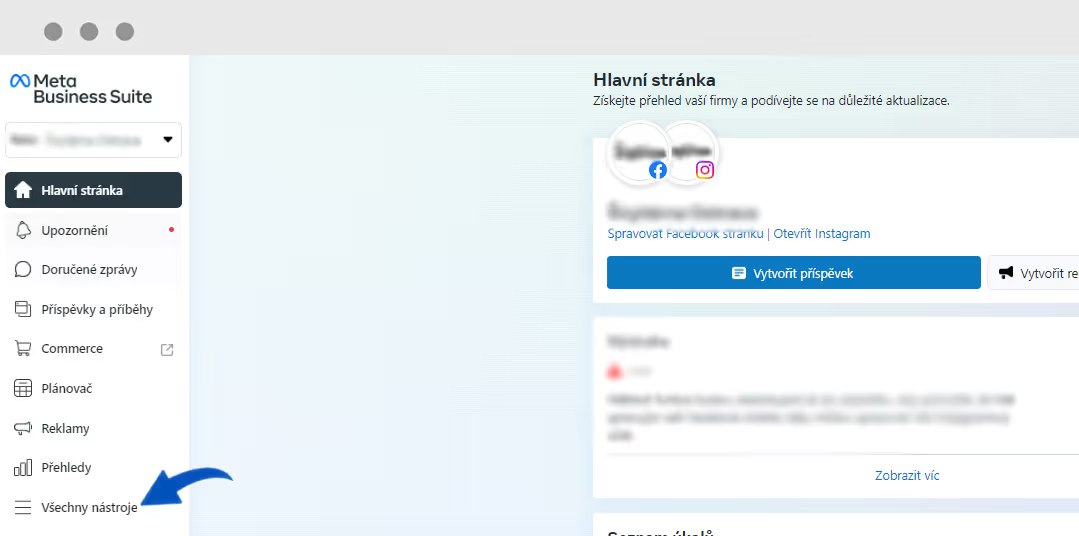
Facebook Business Manager is essential when you want to start running Facebook ads, and here we will show you how to set it up.

An interview about performance advertising and current trends.

3 days of the most interesting PPC know-how. That was the 14th PPC Camp, where we enjoyed 20 presentations from industry leaders that were definitely worth listening to.
Don't miss any important events or news from our world